
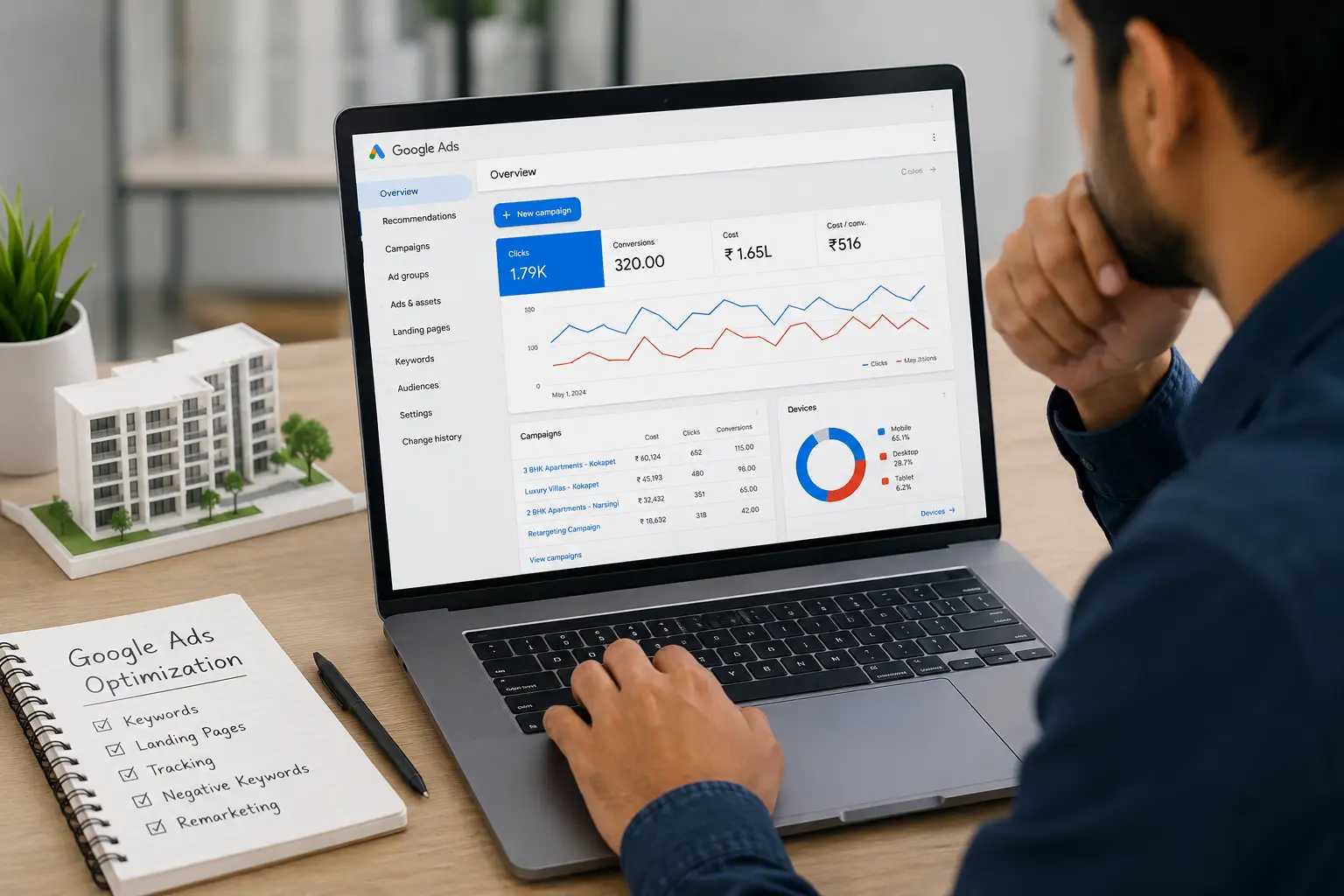
Real estate Google Ads often generate low-quality leads because of broad targeting, weak landing pages, missing conversion tracking, and poor campaign optimization. Builders can improve lead quality without increasing budget by refining keywords, improving landing pages, tracking conversions accurately, and optimizing campaigns regularly.
If you're a builder running Google Ads right now, you know the feeling. Clicks and leads come in every week, but when your sales team calls them, half aren't interested or gave fake numbers. The campaign "works" on paper but isn't producing people who actually want to buy or invest, and it rarely comes down to a saturated market. It comes down to specific gaps in how the campaign is built, tracked, and optimized.
A qualified lead has genuine intent to buy within a realistic timeframe, matches your project's budget and configuration, gave accurate contact details, and is in (or open to relocating to) your project's region. An unqualified lead clicked out of curiosity, misread the ad, or was just comparing prices, and that gap is where most of your ad budget quietly disappears.
Low lead quality is rarely one mistake, it's usually smaller issues stacking up:
Every ad, landing page, and brochure your real estate digital marketing agency creates carries legal weight. A generic marketing team that's used to working with retail or SaaS clients often doesn't think about RERA registration numbers, disclaimers, or how possession-date claims need to be worded. A specialized real estate marketing agency builds compliance into the creative process from the start, not as an afterthought before a launch deadline. Ask any agency you're evaluating how they handle RERA disclosures in ad copy. If they look unsure, that's your answer.
2. Production Capabilities Should Be Bundled, Not Outsourced
Broad keyword targeting. Terms like "flats in Hyderabad" pull huge search volume with little relevance. A builder advertising luxury villas in Kokapet using "houses for sale" can end up reaching buyers looking for affordable homes elsewhere in the city. Location and configuration-specific keywords consistently outperform broad ones.
Landing pages that don't match the ad. If your ad promises "3BHK apartments in Kokapet starting at ₹1.2 Cr" but the visitor lands on a generic homepage listing multiple projects, they are more likely to leave without enquiring. A strong landing page mirrors the ad's promise, includes clear project details, possession status, and trust signals like the RERA number. Read our Website Development for Real Estate guide to learn how page structure improves conversions.
Missing or broken conversion tracking. Without proper Google Analytics 4 (GA4) and Google Tag Manager (GTM) setup, Google optimizes for clicks and form submissions instead of actual lead quality, which is one of the most overlooked reasons cost per lead (CPL) increases over time.
Weak ad copy and no negative keywords. Price-focused ad copy attracts people who are only comparing prices, while missing negative keywords allows ads to appear for irrelevant searches like "flats for rent" or "real estate jobs."
No remarketing. Most property buyers don't convert during their first visit. Without remarketing campaigns, builders miss the opportunity to reconnect with visitors who have already shown interest.
No weekly optimization. Search terms, bid adjustments, and underperforming keywords require regular reviews. Campaigns left untouched for weeks gradually become less efficient and generate lower-quality leads.
Before increasing your advertising budget, most builders can improve campaign performance by optimizing what is already running:
Audit your search terms report weekly and add irrelevant searches to your negative keyword list.
Rebuild your campaign structure around specific projects, property configurations, and target locations.
Match landing pages to each ad group instead of directing all traffic to a generic website page.
Set up accurate conversion tracking using Google Analytics 4 (GA4) and Google Tag Manager (GTM) before making optimization decisions.
Rewrite your ad copy with specific project details, price ranges, and RERA information to attract more qualified buyers.
Implement call tracking so phone enquiries are measured alongside form submissions.
Use remarketing campaigns to reconnect with visitors who showed interest but didn't convert during their first visit.
Increasing the budget on a poorly structured campaign usually generates more of the same low-quality leads. Broad Match keywords and Performance Max campaigns can deliver excellent results, but only when supported by a well-maintained negative keyword list and accurate conversion tracking data.
| Problem | Why It Happens | Recommended Fix |
|---|---|---|
| High CPL, Low Conversions | Broad keyword targeting pulls irrelevant traffic. | Shift to phrase match or exact match keywords and maintain a strong negative keyword list. |
| Leads Don't Answer Calls | Landing page doesn't match the ad's promise or user intent. | Create campaign-specific landing pages that align with each ad group. |
| CPL Rising Over Time | Missing or broken conversion tracking prevents accurate optimization. | Implement Google Analytics 4 (GA4) and Google Tag Manager (GTM) conversion tracking. |
| Leads with Fake Details | Low-friction forms encourage curiosity clicks instead of genuine enquiries. | Add qualifying form fields and set clear expectations in your ad copy. |
| Low CTR Despite Good Targeting | Generic or weak ad copy fails to attract qualified buyers. | Rewrite ads with specific project details and clear value propositions. |
| Visitors Don't Return or Convert Later | No remarketing campaign is running. | Launch remarketing campaigns to reconnect with interested visitors. |
Cost per lead tells you how much you're spending, not whether it's working. A fuller picture includes qualified leads as a percentage of total leads, sales calls connected, site visits booked, and return on ad spend (ROAS). Builders who track only CPL can end up keeping a campaign that looks efficient but isn't producing sales.
A single-project campaign can often be managed in-house. It makes sense to bring in a specialized agency when multiple projects run across locations, CPL keeps rising despite internal efforts, or conversion tracking feels overwhelming. Our guide on How to Choose a Digital Marketing Agency for Real Estate walks through what to look for.
At VisualHash Technologies, we work with builders and developers across Hyderabad on the exact issues covered in this article. Our approach starts with a review of the existing campaign structure, landing pages, and tracking setup before recommending any changes, and can include Google Ads restructuring, landing page design, SEO, GA4 and Google Tag Manager setup, and AEO/GEO optimization. We don't promise a fixed number of leads or guaranteed rankings. If your campaigns are generating clicks but not qualified enquiries, the right starting point is usually a campaign audit, not a bigger budget.
Low-quality Google Ads leads are rarely caused by the platform itself. In most cases, they result from broad targeting, mismatched landing pages, inaccurate conversion tracking, or campaigns that haven't been optimized regularly. Instead of increasing your budget, focus on building a well-structured, data-driven campaign that matches how your buyers search and make decisions.
Digital VR AR Blockchain Virtual Tour Website Digital Marketing Graphic Deisgn Creative Brochure Drone Shoots Walkthrough DM Logo

Blockchain is a distributed database which has the potential to act as decentralized systems, transforming industry structures and drive large-scale shifts in the business model of organizations.