
Blogs

Calculating ROI for Virtual Reality (VR) Adoption in Real Estate Companies

VR
Virtual Reality july 7, 2025

What Does ROI Mean in VR for Real Estate?

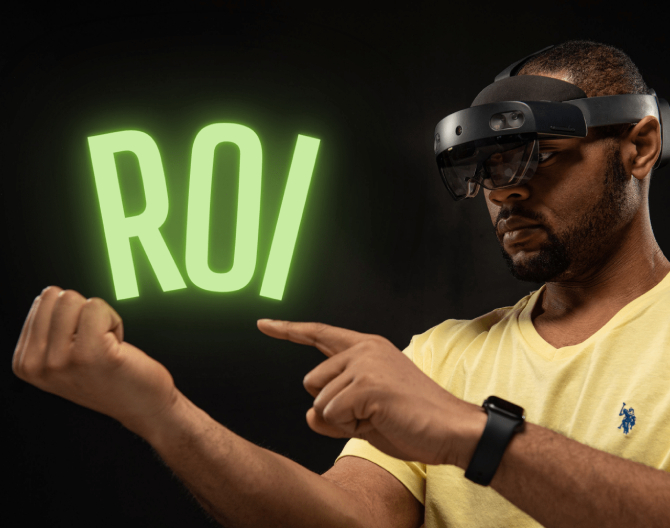
ROI (Return on Investment) in virtual reality for real estate refers to measuring how much profit or business value a company gains compared to the money invested in VR technology such as virtual tours, walkthroughs, and immersive property experiences.

Introduction

Virtual Reality (VR) is transforming the way real estate projects are marketed and sold. From virtual site visits to immersive walkthroughs, VR helps buyers experience properties remotely. However, before adopting VR, real estate companies must understand whether the investment is profitable. That’s where ROI calculation becomes essential.

What is Virtual Reality (VR) in Real Estate?

Virtual Reality in real estate allows buyers to explore properties digitally using 3D environments, 360° walkthroughs, and immersive simulations. It is widely used for:

  • Virtual property tours
  • Remote site visits
  • Pre-launch project showcases
  • NRI and international buyer engagement

Why Calculating ROI for VR is Important

Understanding ROI helps real estate companies:

  • Justify technology investment
  • Improve sales efficiency
  • Reduce physical site visit costs
  • Increase buyer engagement and trust
  • Make data-driven marketing decisions

Key Costs Involved in VR Adoption

Before calculating ROI, identify all costs involved:

1. Hardware Costs

  • VR headsets
  • 360° cameras
  • Supporting equipment

2. Software Costs

  • VR tour creation platforms
  • 3D visualization tools
  • Hosting and maintenance

3. Training Costs

  • Staff training for VR usage
  • Sales team onboarding

4. Marketing Costs

  • Promoting VR experiences
  • Digital campaigns and landing pages

Measuring the Benefits of VR in Real Estate

Increased Sales Conversions: VR helps buyers make faster decisions, leading to higher booking ratios.

Reduced Time on Market: Properties with virtual tours often sell faster than traditional listings.

Better Customer Experience: Buyers can explore properties anytime, anywhere, improving satisfaction.

Operational Efficiency: Fewer physical site visits reduce time, manpower, and logistics costs.

ROI Calculation Formula

Use this standard ROI formula:

ROI = (Net Profit ÷ Total Investment) × 100

Net Profit: Total Benefits – Total Costs
Total Investment: All VR-related expenses

Example ROI Calculation

If a real estate company invests ₹10,00,000 in VR and generates an additional ₹25,00,000 in sales:

  • Net Profit = ₹25,00,000 – ₹10,00,000 = ₹15,00,000
  • ROI = (15,00,000 ÷ 10,00,000) × 100
  • ROI = 150%

Intangible Benefits of VR Adoption

Some benefits are difficult to measure but still valuable:

  • Stronger brand image
  • Higher customer trust
  • Better NRI engagement
  • Competitive market positioning

VR ROI in Real Estate

VR ROI measures profit from using virtual tours and 3D walkthroughs. VisualHash helps maximize ROI with immersive property experiences.
VisualHash VR allows buyers to explore properties remotely, boosting engagement, faster decisions, and higher booking rates.
VisualHash provides 360° virtual tours, 3D walkthroughs, drone integration, and NRI-focused immersive experiences.
VR by VisualHash enables NRIs and global buyers to experience properties online without traveling, increasing trust and bookings.
VR improves sales conversions, reduces site visits, enhances customer experience, and strengthens brand image.

Tags

Digital VR AR Blockchain Virtal Tour Webiste Digital Marketing Graphic Design Creative Brochure Drone Shoots Walkthrough DM Logo


blockchain

Where Information Lives

Blockchain is a distributed database which has the potential to act as decentralized systems, transforming industry structures and drive large-scale shifts in the business model of organizations.






Latest Articles

Latest Articles